As close to the source as possible
Every branch from the battery should be protected at the battery; the cable before the fuse is unprotected.
Calculator
Enter the power or current of the load and the cross-section of the cable. You get the next common fuse rating and whether your cable can carry it.
The result is guidance based on your input. Manufacturer instructions and local regulations always take precedence; you remain responsible for the installation.
That is the core of it: the fuse should blow before the cable overheats. So the rating sits above the continuous current of the load — often 25 % above, to survive normal peaks — and below what the cable can carry. If that does not fit, the cable is too thin rather than the fuse too small.
Every branch from the battery should be protected at the battery; the cable before the fuse is unprotected.
Blade fuses for small loads, MIDI and MEGA or ANL for main currents; watch the interrupt rating with lithium.
Motors, fridges and inverters briefly draw far more than their continuous current; use the peak from the datasheet.
Designing a complete electrical system? In WireElectric you place fuse holders, busbars and loads in the diagram, and the app checks per circuit whether the protection matches the cable and the load.
You can start drawing without an account.
Open WireElectric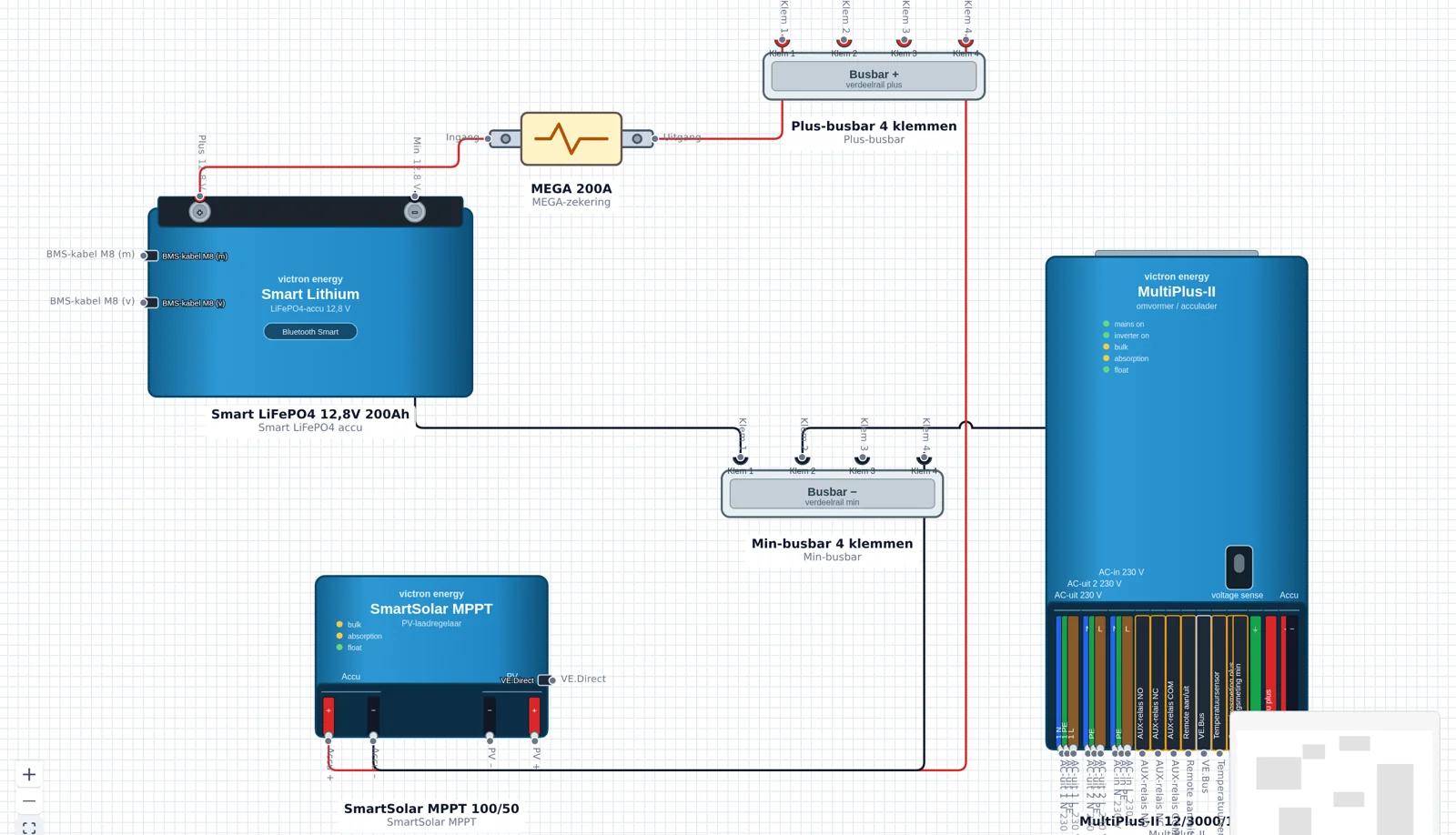
Every calculator answers one question about your installation. WireElectric then runs the same calculations for every connection in your complete diagram.
Find the cross-section that suits your 12V or 24V system, based on current, length and voltage drop.
View →Check how much voltage you lose over a cable and what reaches your load.
View →Work out how much battery capacity in Ah you need for your daily use and autonomy.
View →Calculate how long a battery can power a load, including the usable share and inverter losses.
View →Convert power straight to current at 12V, 24V, 48V or 230V.
View →Work out indicatively how many Wp of solar panels your daily consumption needs.
View →