Boat 24V with solar and shore power
24V service bank with SmartShunt, alternator charging through an Argofet, two solar panels on an MPPT, MultiPlus with shore power and a 230V circuit with RCBO.
View this example diagram →Example diagrams
Five worked installations with battery, fuses, main switch, charge controller and inverter — each diagram shows exactly which parts it uses and what they are wired to.
Every example is a real WireElectric design: open it in the editor with one click and adapt it to your own installation. The checks then follow the voltage of each net, the cable size and the fuse rating.
24V service bank with SmartShunt, alternator charging through an Argofet, two solar panels on an MPPT, MultiPlus with shore power and a 230V circuit with RCBO.
View this example diagram →Battery with main fuse, main switch, SmartShunt, busbars and a fuse box feeding two 12V loads.
View this example diagram →Complete camper system: solar with MPPT, alternator charging through an Orion-Tr Smart, MultiPlus with shore power and a 230V circuit, plus 12V loads behind a fuse box.
View this example diagram →Starter battery charges the house battery through a fused Orion-Tr Smart DC-DC charger, both grounds bonded to the chassis.
View this example diagram →48V battery bank on a Lynx Distributor, solar panels on an MPPT 250/100, MultiPlus-II with grid connection and a consumer unit feeding 230V loads.
View this example diagram →WireElectric does not calculate this in isolation but for every connection in your own diagram: place the real components, draw the cables and see straight away where the cross-section, the fuse or the voltage drop is off.
You can start drawing without an account.
Open WireElectric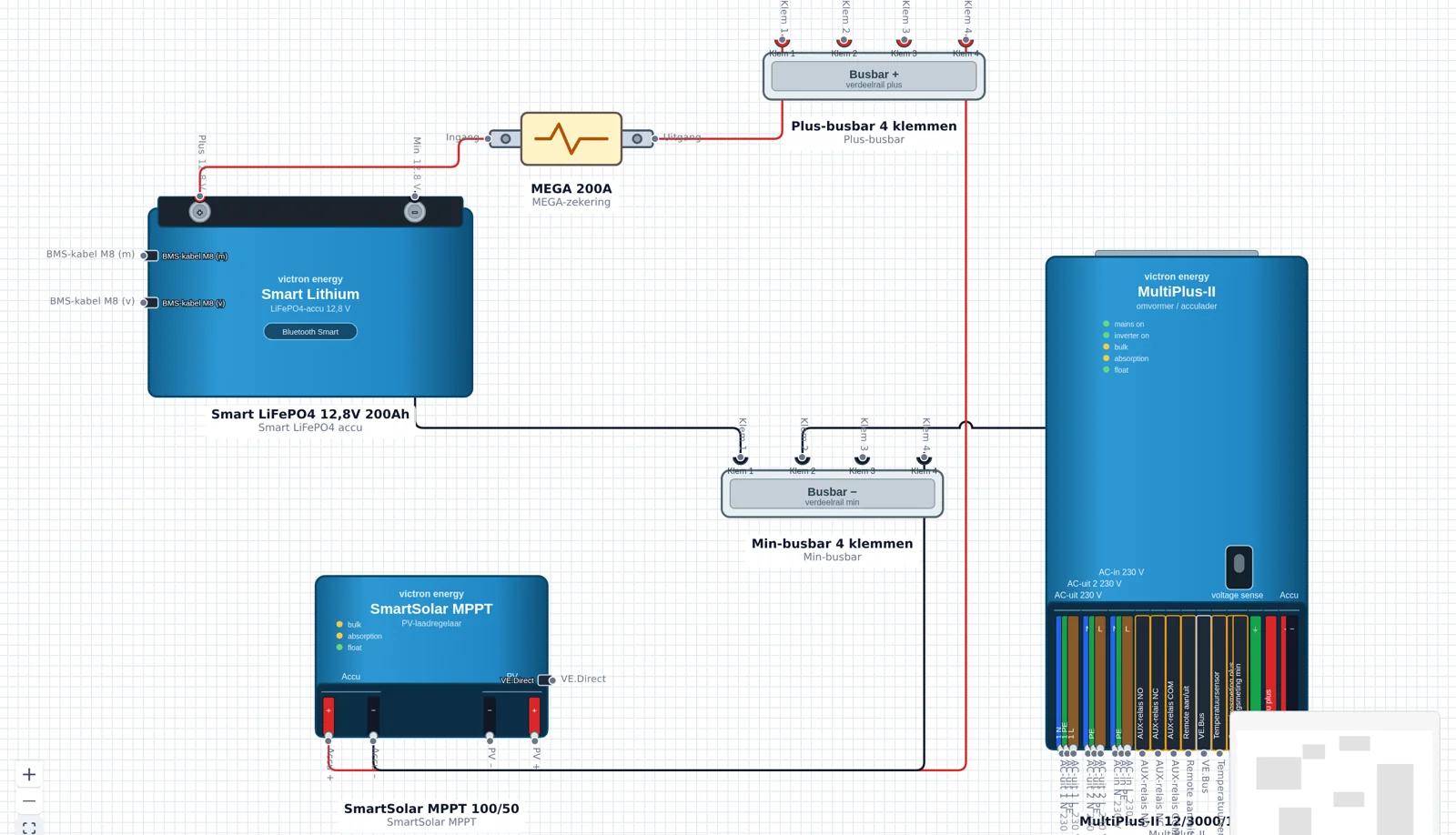
Every calculator answers one question about your installation. WireElectric then runs the same calculations for every connection in your complete diagram.
Find the cross-section that suits your 12V or 24V system, based on current, length and voltage drop.
View →Find a suitable fuse for your circuit, including a check on whether the cable can carry it.
View →Check how much voltage you lose over a cable and what reaches your load.
View →Work out how much battery capacity in Ah you need for your daily use and autonomy.
View →Calculate how long a battery can power a load, including the usable share and inverter losses.
View →Convert power straight to current at 12V, 24V, 48V or 230V.
View →Work out indicatively how many Wp of solar panels your daily consumption needs.
View →